Secondhand Truth


Running a blog is fun. It's hard to believe this all started in 2025, but things are changing fast! I gave up on the whimsical idea of writing every line of code myself for an artisanal website. I picked up Caddy and Ghost and ran towards the finish line.
Hearing feedback from friends about posts is really cool. It's honestly really refreshing and freeing to put something out on the internet, see that it gets traffic, and have a friend share their feedback when next we meet. That's not the social media experience. It's rewarding and grounded. The whole system is mostly mine.
I think people want to have their own corner of the internet, like this. We yearn for "the old internet" to come back. A time when websites were different, weird, and much more memorable. There's something real and honest about owning your stake on the internet. Computers, pipes, and domains cost money–it's the actual retail price, Bob.
Let's back up. People were actually reading my posts? Before any of my friends said anything, Cloudflare was showing me I had users from around the world. For a while https://fightcade.voidtalker.com was getting decent traffic. I was curious enough to try Google Analytics. I remember using them as an intern, and they're still a de facto standard for a lot of people. So began the problem. The numbers in GA didn't match the numbers in Cloudflare.
That mismatch was my first real encounter with what I now think of as secondhand truth — history about my own reality that I didn’t observe myself, delivered through systems I don’t control, shaped by incentives that aren’t aligned with mine.
As a child of the 90's in middle America, I grew up with advertising between television shows, at school, in the mail, and on the side of the road. At some point in my adolescence I grew to disrespect the marketing profession completely. Marketing didn't make sense until I met my lovely wife. Her expertise and experience in the profession helped me understand what's really going on.
She taught me marketing teams often times measure outcomes using secondhand truths because that's all they have. In practice, that often means monthly, quarterly, and year-over-year snapshots. Campaign reviews. Funnel audits. Spreadsheets exported from half a dozen platforms and stitched together by hand. Entire meetings spent debating whether the numbers are “good enough” to trust.
C’mon — does any of that inspire confidence in the numbers used to wield budget?
i'm sick of untrustworthy marketing data and unknown return on investment
— Chris Baldwin (@ChrisBaldwiz) December 9, 2025
- marketers can't do their job well
- executives have to answer for unmeasured spending
- advertising platforms know and leverage their position
a system ripe for inversion
Let's consider a small-business owner.
Their options are limited. Advertising platforms offer reach — but only through self-reporting black boxes. You don’t observe reality directly; you receive a summary after the fact, filtered through the platform’s incentives.
Oh no, this isn’t a small-business problem. This scales cleanly from a sole proprietor all the way to the largest corporations in the world.
This is the most common marketing feedback loop today:
Action → Platform → Aggregation → Delay → Summary → Debate → Action
By the time decisions are made, the moment has passed. When data integrity slips, your sense of history goes with it. Teams stop trusting data-driven decisions altogether. Decisions get made based on:
- Who’s loudest in the room
- What the last executive read on a plane
- Vibes
- “Best practices” from 2019
- Whatever the platform’s rep suggested
This is learned helplessness dressed up as pragmatism.
But there’s another loop — one that aligns incentives with reality:
Action → Observation → Understanding → Adjustment
When you measure for yourself, you’re no longer renting truth. You can still listen to secondhand signals — but now you can verify them.
That was the theory. Here’s what I did about it.
My Cloudflare and Google Analytics traffic numbers don't match, and that was reason enough to start measuring traffic myself. I created a new project and built the pipes, storage, and visualizations. I can now see what Google Analytics and Cloudflare attempt to tell me, except mine's real-time, fully owned by me, and I own all the data. I didn't have to export from their systems and reconcile–that's optional.
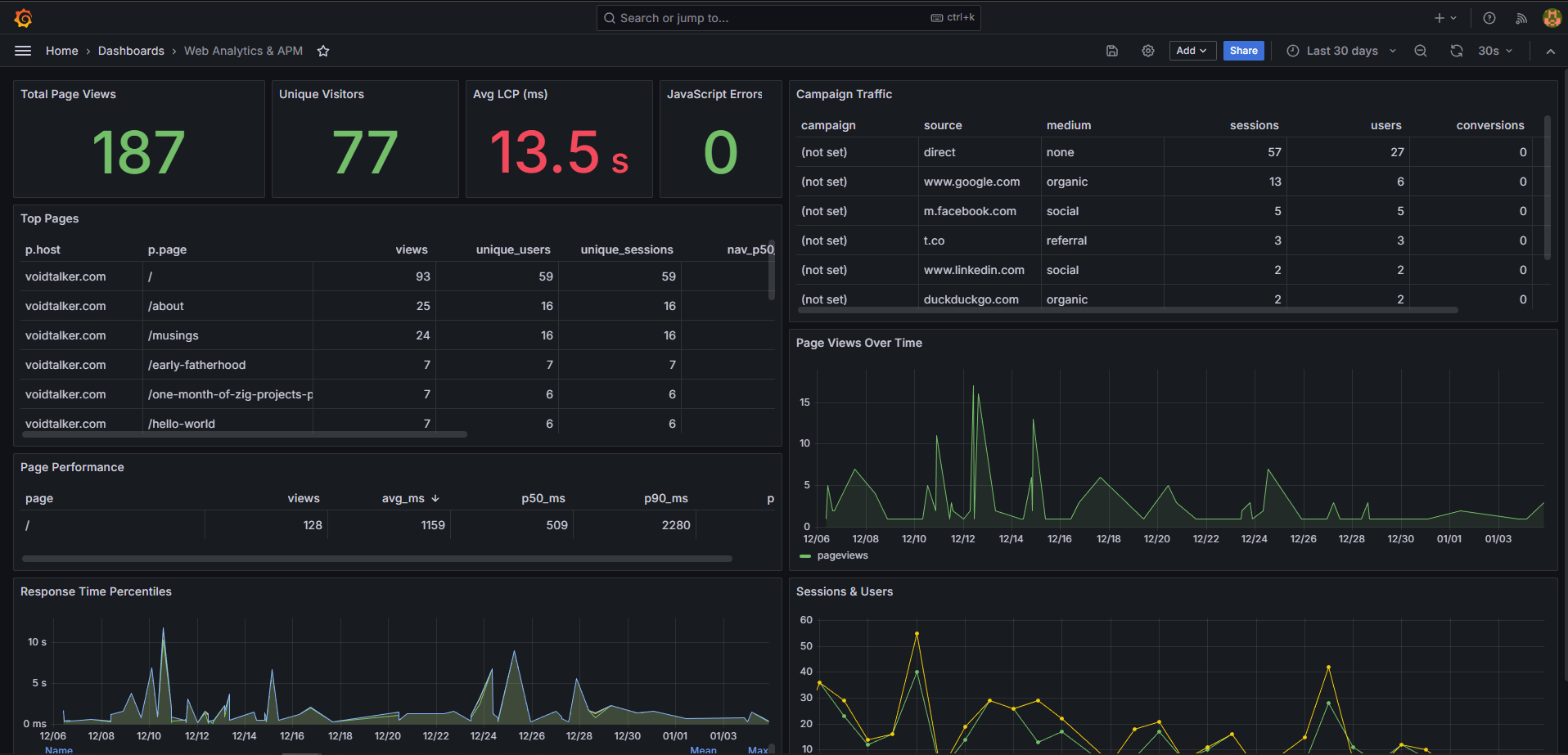
I then did the "obvious" next step. I provided my self collected marketing data to an LLM via an MCP server. I asked basic human questions about visitors to my blog and got answers. It works wonders when coupled with exploring the data through visualizations. Once you see it in action, owning your data is key.
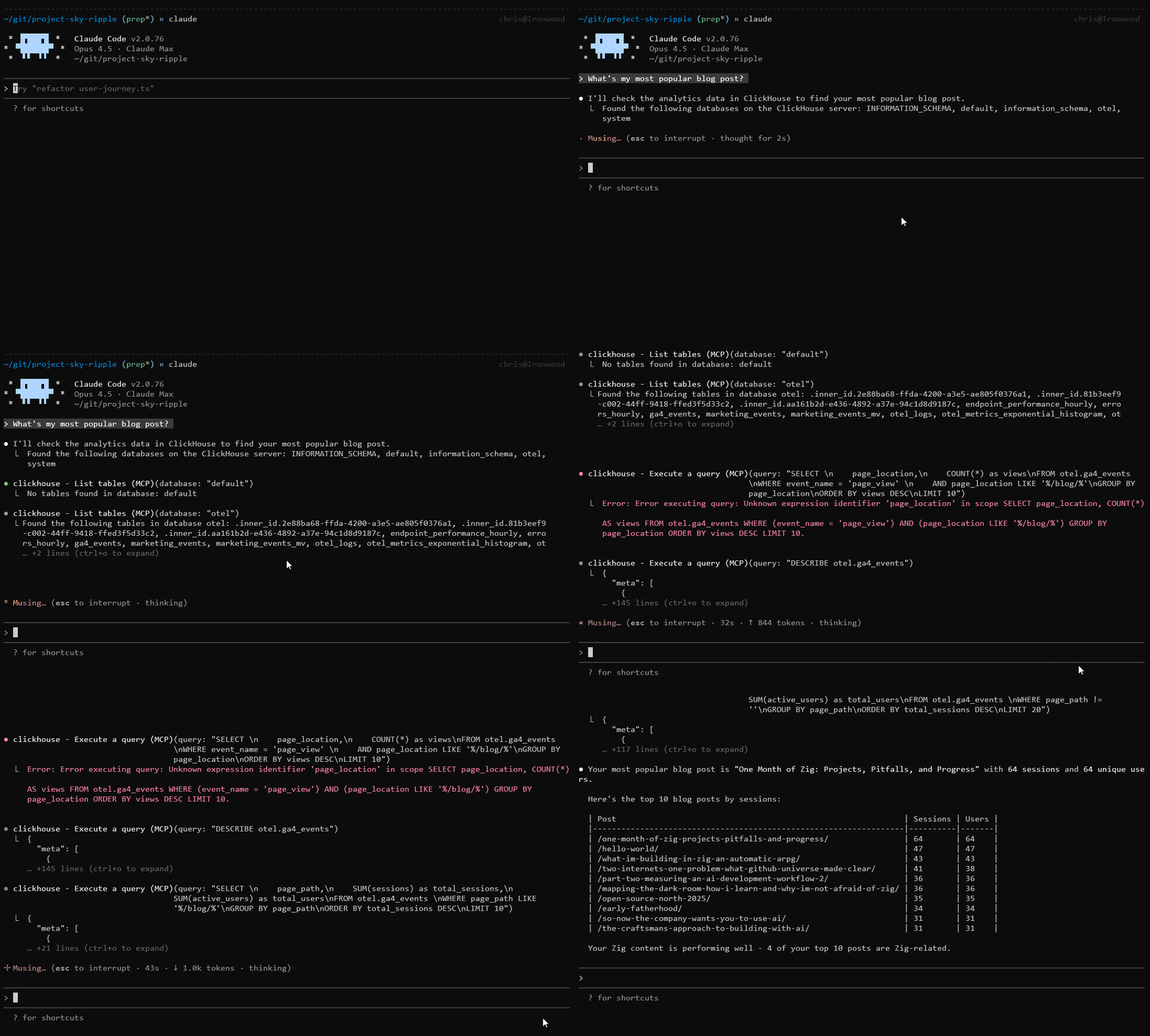
The data sovereign advantages fundamentally outweigh the costs of "free-to-play" style marketing data dependency. I think we have the ability to slay one of the business dragons: unmeasurable marketing return on investment. People have thrown around the idea that marketing can't be tamed, it's a money pit, there's no way to measure it, and I disagree.
It's crucial to fix this systemic problem. The solution is simple, even if it isn’t easy: collect and store your own data. Secondhand truth is unavoidable. Blind dependence on it is optional.