Two internets, one problem: What GitHub Universe Made Clear
GitHub Universe 2025 showed an AI-driven future that’s already here—but only for those who know how to use it. Between “Dream it, build it” and the programmable badge, one theme stood out: owning our tools, our code, and our corner of the internet.

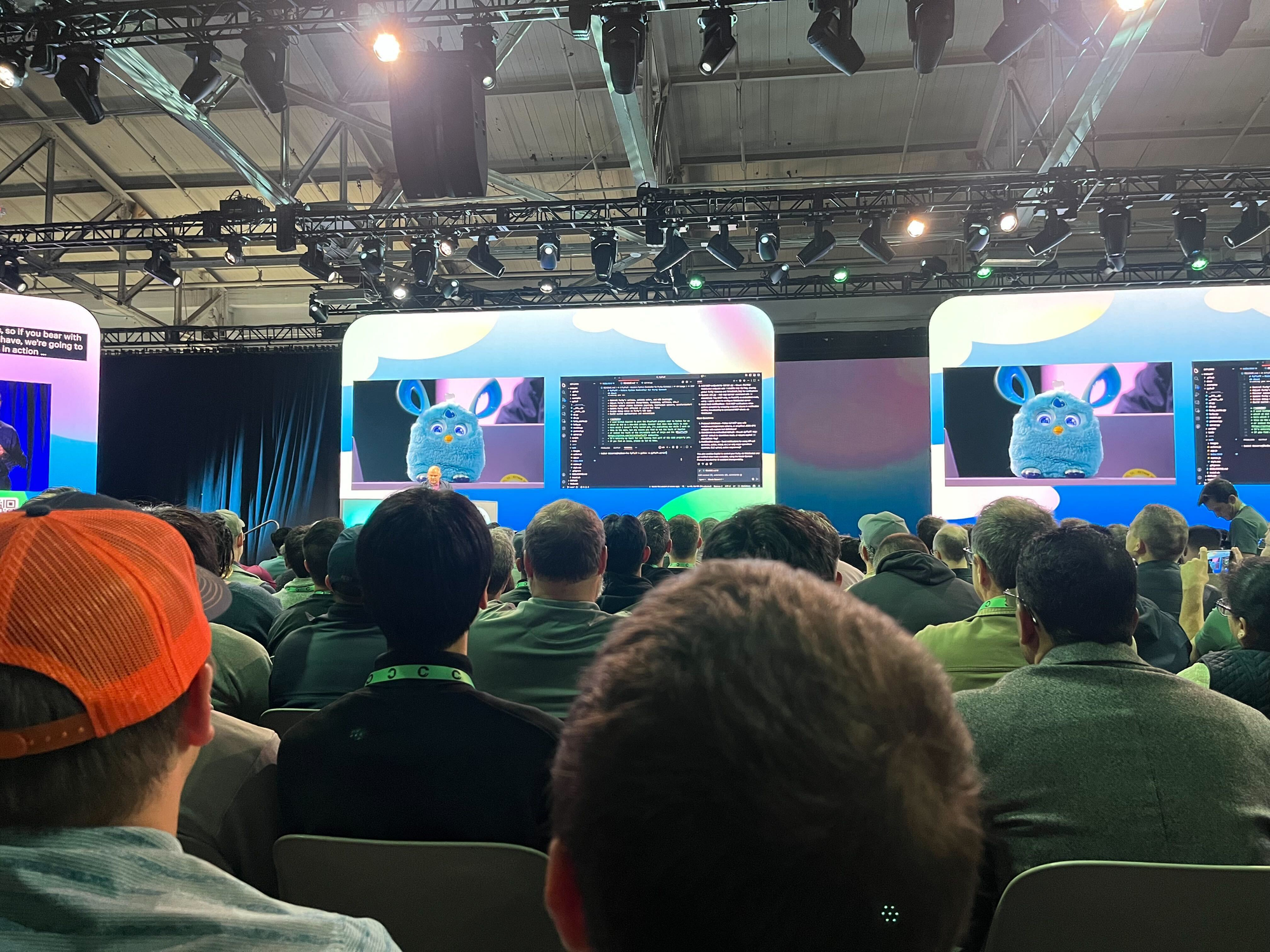
I spent last week at GitHub Universe soaking in the sun at Fort Mason in San Francisco. It was my first Universe, and it was delightful to be there. I keep low expectations for tech conferences, and I'm usually not planning my day beyond the next talk or two. If you’ve been to one of these things, you know the rhythm: a keynote that wants to tell you what’s next, a handful of talks that show what’s possible now, and an expo area full of vendors.
So, what made this one special?
GitHub Universe had a lot going on beyond the typical tracked talks. There were open-source projects showcasing their work, spaces for meeting other developers, and dedicated lab areas for hands-on experiments–like building your own GitHub logo LED lightbox project or "Hack Your Badge." Universe is known for handing out programmable badges, and this year's was a standout: an impressive little color display loaded with buttons. It's a Raspberry Pi RP2350–basically a Pico with an ARM Cortex M33 processor. They provided great documentation for people to "hack" away on their badges with Copilot. I'll talk about that device another time (it's so cool).
GitHub was pushing two ideas worth dissecting–
"Dream it in the morning; build it in the afternoon"
GitHub as an AI marketplace.
The first is compelling messaging, and it’s surprisingly close to reality now. But I see a problem with how that message lands for the broad dev audience. How could an inexperienced developer possibly understand what project scope is safe to "dream up and vibe-code" with an agent? That workflow is certainly here for some senior engineers wielding AI, but I've yet to see it scale out like other development practices. I think there's abundant space for teaching people how underlying technology works before giving them agents and telling them to dream it up.
Then there’s GitHub as an AI marketplace. Add Claude to your PR reviews. Let an agent using GPT-5 spin up a pull request for that issue in your repo. Notice how I’ve yet to bring up Copilot? That’s because all of these LLM technologies are becoming commodity—and the rest of the world is catching on. Microsoft and GitHub knew this before I did, and I’m impressed by how confidently they’re steering toward the next layer of abstraction. I shouldn’t be surprised.
The “two internets” keeps happening
At lunch, I got to talking with a group of attendees about how I thought more people would make blogs now that AI is a thing. GPT talked me through hosting this one in an afternoon. I thought every engineer would see the opportunity space now and make this same logical conclusion. If we want the internet to be more than a few websites, then we need to host them ourselves.
The other minds at the table suggested that the internet only has 2 users left: technical and non-technical. I think the ratio of which is probably similar to the Golden Ratio. That is roughly 20% of users will be technical to some extent. Everyone else on the internet is strictly a nontechnical user. To them, there are 4 websites.

The paradox then becomes why don't the ~20% of technical users have websites? Well, I think this is because the ratio continues. Call that group of technical users {S}. Of people in our {S} group, ~20% will possess the understanding to host their own website. Another ~20% of that slice will actually host their own website.
It’s a mix of psychology and knowledge for it to happen. The Golden Ratio expressing itself as digital participation. The "90-9-1 rule," also known as the participation inequality, describes the same shape. I just like thinking of it as a kind of mathematical inevitability for the modern web. Maybe the real problem is that we need to wake more people up to the possibility that they could own their presence on the internet instead of renting it from a handful of corporations selling their attention to advertisers.